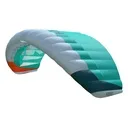
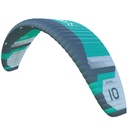
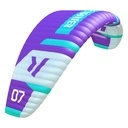
Foil kite for kitesurfing: the holy grail of light wind, and more
A foil kite doesn't have inflatable struts. Its shape is maintained by the bridle and the air that rushes into its cells.
Updated September 29, 2026. Our Pornichet store stocks a range of foil kite s: the Flysurfer Soul 4 2027 (€1,799), Sonic 5 (€2,199), Hybrid V2 (€899), Heli 2026 (€1,399), and Peak V6 (€599). All prices include tax. To help you choose between a foil kite, a light wind kite with struts, or a kitefoil, check out the light wind section of our guide to choosing your kitesurf kite.
In summary
- Built from super-light spinnaker fabric, it stays airborne even when a strut kite would fall under its own weight.
- Foil kites were designed for light wind. The rise of kite foiling has brought them back to center stage.
- Projected area: approximately 80% of the total area on a race foil kite (a Flysurfer Sonic 11.4 m² gives 9.4 m²), compared to about 65% on a freeride inflatable kite (a 12 m² kite gives 8 m²). The freeride inflatable kite has a strut.
- Power benchmark: a 15 m² strut kite is roughly equivalent to a 12 m² race foil kite.
A foil kite doesn't have inflatable struts. Its shape is maintained by the bridle and the air that rushes into its cells. Built from super-light spinnaker fabric, it stays airborne even when a strut kite would fall under its own weight.
In summary
Foil kites were designed for light wind. The rise of kite foiling has brought them back to center stage.
- Projected surface: approximately 80% of the total surface on a race foil kite (a Flysurfer Sonic 11.4 m² gives 9.4 m²). This compares to about 65% on a freeride strut kite (a 12 m² gives 8 m²).
- Power benchmark: a 15 m² strut kite is roughly equivalent to a 12 m² race foil kite.
- No pump needed. Just unfold, weight it down, check your lines, take off solo, and land solo in backstall.
- The mixer adjusts three parameters simultaneously: angle of attack, projected surface, and profile camber. This results in a very wide wind range.
- Water relaunch is no longer an issue. With a revised bridle, moderate aspect ratio, and taped seams, a Flysurfer Soul relaunches every time.
Who hasn't wondered about the appeal of these complex, expensive kites that don't need a pump and fly in the lightest breeze?
With the advent of foil, more and more riders are interested in foil kites. This type of kite is still a minority on the market, but an increasing number of silent gliding enthusiasts in light wind are giving them a try. Foil kites in stock are in the kite section of the store.
In this article, we will trace the brief history of these unique kites. Then, we will try to understand what foil kites truly offer compared to kites with struts. We will then look at the technical aspects of these kites and what differentiates them. Finally, we will focus on the Flysurfer range in particular.
In the early days of kitesurfing, foil kites were the very first available on the market, even before the advent of the Legaignoux brothers' Wipika kites. This was the time of powerkiting and beach jumps with kites without depower. Then, kites with struts largely took over.
Inflatable kites offer simple setup, lower production costs due to less seam work, and easier water take-off. The struts are a key part of this design.
For many years, foil kites were marginal in the kite market. The focus was more on wave riding and freestyle, even though most riders were doing basic freeride.
A few dedicated riders continued to favor foil kites for various reasons. These included their versatility for maritime, mountain, mountain-board, and buggy riding. The same kite could be used for snow-kiting in winter, then on lakes and at sea.
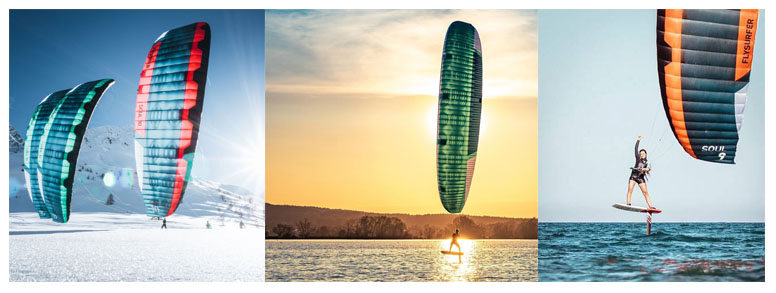
Others appreciated these kites for their performance in light wind, especially in very large sizes. Kites with struts were quickly disadvantaged due to their weight beyond 12-13 m². And inflating a large size was always a pain.
The release of the legendary Speed 3 21m² in 2011 was a revelation for some. This kite allowed riding in a wind range unimaginable with a strut kite. It became possible to ride in less than 6 knots on large Twintip boards (doors). This practice was still niche, but what a thrill to ride silently on perfectly smooth water. And there was also that slightly selfish pleasure of being the only one on the water while riders with strut kites waited on the beach for the wind to pick up. This kite was gigantic and generated phenomenal power, but had the agility of a mammoth.
It was around this time (10 years ago already) that the video "Mirrors" was released on YouTube. It showed unreal riding on an absolutely smooth body of water. It was completely insane to see what a foil kite could do in marginal wind, while foil kiting was still in its infancy and elitist.
Today, with kite foil as a new riding discipline, you might think this would spell the end for these very slow, large foil kites. After all, it's now possible to ride in less than 8-10 knots with a good kite foil and an ultra-light inflatable kite like the Juice from Duotone or the OS from Eleveight. Yet, the opposite is happening. Foil kites, whose design is fundamentally dedicated to light wind, make lightwind foiling even more appealing.
So what are the advantages of these kites? Why such a resurgence of interest?
Kite weight:
The primary advantage of foil kites is the kite weight-to-surface ratio. They do not fall with their own weight when the wind drops and remain airborne up to the last limits of flight mechanics. Foil kites are constructed from very light spinnaker fabric. They do not need to be reinforced because they are not subjected to the same stresses as kites with a strut. On foil kites, only the bridle ensures the hold and shape of the kite.
The bridle maintains the kite's structure and shape. The rider's weight is distributed across a much larger bridle than on an inflatable kite. Inflatable kites also have to withstand 10-15 PSI of strut pressure and a limited number of bridles. This often means multiple layers of dacron fabric and various reinforcements, all of which add weight to the overall structure.
The second is the ability to build kites with a much flatter design than that of a strut kite. This results in a larger kite size-to-projected area ratio. The trade-off for this approach is a relatively slower turning speed.
For freeride strut kites, a 12m² has a projected area of 8m², a 10m² about 7m². So, roughly 65% of the kite's surface is used for traction.
Race foil kites, like the Sonic from Flysurfer, offer a different story. For example, an 11.4m² kite provides 9.4m² of projected area, and a 14.6m² kite gives 12.1m². This means 80% of the kite is used for traction.
So, it is important to remember that with a 15m² strut kite, you have the projected area of a 12m² race foil kite. This gives approximately the same order of magnitude in terms of power.
Wind range and progressive depower:
Another advantage of managing a foil kite with complex lines and pulley systems (Mixer) is the ability to adjust three parameters simultaneously with bar movement.
The first action is the change in the kite's angle of attack, which is quite classic and also found in strut kites. This is the basic depower for handling gusts.
The second action is variation in projected area. When you pull the bar, foil kites deform, increasing their projected area by changing the canopy. The kite transitions from a well-rounded arc shape to a much flatter one with a single bar movement. This effect is less easy to achieve with a strut kite, because it has a rigid structure that prevents large deformations.
The third action is the camber of the profile. When you sheet in your kite, it cups and the Trailing Edge tilts. You can compare this to airliner wings deploying their brakes at the rear during landing. The goal is to increase the kite's lift.
These three actions, combined with the generally flat profile of foil kites, allow for very wide wind ranges. The depower, while less instantaneous than on a kite with struts, is significant. The asymmetrical deformation of the kite is also a good way to make it turn faster. This is particularly interesting on race-oriented kites like the Sonic. By applying the left-right differential on the bar, you effectively twist the kite for a better turn.
Here's a small example of a possible turn in backstall Twist mode:
My new game: The Helico Kite, a Tatahi video on Vimeo.
Upwind performance:
Let's be clear: a medium/high aspect ratio foil kite is unbeatable upwind. Even with the latest trendy strut kite, forget about trying to compete with a well-ridden foil kite. You'll get smoked.
The first time you launch a foil kite, one thing immediately stands out. The kite climbs high in the wind window. You'll find the kite at the zenith, rising vertically above the rider, or even a bit further, without any front stall. The harness pulls, sometimes even riding up to your navel. This is normal, and we recommend using very good harnesses in medium-to-high wind conditions. The traction in the hook is significant and comes at unusual angles compared to strut kites. In practice, the kite goes very, very far into the wind window. When riding, you'll find yourself sailing with unreal angles.
The range:
With a foil kite, you don't need a pump. Unfold it, weight the kite, check your lines, and then launch and ride. We don't recommend getting assistance. In light wind, you can also land alone by braking your kite (backstall), just like a paraglider. This is a huge advantage when foiling, as you're often alone at the spot with no one to help. It's also a great way to explore places where no one else rides.
Hangtime:
Simply put, the hangtime of a medium/high aspect ratio foil kite is monumental. This completely transforms your riding style. You can ride and fly with these kites. Imagine the pleasure of sending it big, calmly, over 8 meters high, and staying there without too much effort or technique. That's the real pleasure, whether you're on a twintip or a foil. The jumps are insane, yet incredibly smooth. You don't need bionic knees to absorb the landings, because you land like a feather, even after a ride 10 meters high for several long seconds. There's no need to throw a kiteloop at the end of the jump to cushion the fall, which is slow and very refined.
Water relaunch:
This is the main concern when switching to foil kites. A foil kite doesn't relaunch in the water.
That statement was never truly accurate. It's undeniable that just a few years ago, relaunching a foil kite tangled in its lines on the water demanded significant skill.
That's no longer the case. A new generation of foil kites has emerged. These kites feature a specific bridle and a moderate aspect ratio. These advancements prevent the kite's canopy from snagging in the lines. The combination of highly sealed canopy fabric and seams, along with new waterproofing and water-repellent treatments, makes these kites fully relaunchable even after extended time in the water. In fact, a Flysurfer Soul, for example, now relaunches every single time. In light wind, a foil kite has a far better chance of relaunching than even the best single-strut inflatable kite.
Ultimately, foil kites deliver genuine comfort and an unparalleled ride feel. They offer nothing but advantages. So this summer, it's time to get out there!
Article written by Obi Volant.
| Criterion | Ram-air kite. | Kite with struts |
|---|---|---|
| Structure | Very light canopy, shape held by the bridle alone | Struts inflated to 10-15 PSI, dacron layers and reinforcements |
| Projected area | Approximately 80% (Sonic 11.4 m² gives 9.4 m²) | Approximately 65% (12 m² gives 8 m²) |
| Light wind | Doesn't fall when the wind drops, flies to the limits of flight mechanics | Penalized by its weight beyond 12-13 m² |
| Setup | No pump, take-off and landing with range | Inflation required, assistance often helpful |
| Upwind performance | Unbeatable upwind, the kite flies very far into the wind window | Significantly tighter angles |
| Hangtime | Monumental, slow and soft landing | Drier landing, kiteloop often necessary |
| Turning | Relatively slow, a consequence of the flat design | More responsive |
| Water relaunch | Achieved with the current generation | Historically, its strong point |
Frequently Asked Questions
Does a foil kite relaunch in the water?
Yes, with the current generation. A specific bridle and moderate aspect ratio prevent the kite's fabric from getting caught in the lines. The use of very waterproof fabric and seams, along with recent water repellents, makes these kites relaunchable even after a long time in the water. A Flysurfer Soul relaunches every time. In light wind, a foil kite has a better chance of relaunching than the best single-strut kite.
Why is a foil kite better in light wind?
For two reasons. First, its weight-to-surface ratio: built with lightweight fabric, without reinforcements or strut pressure to absorb, it does not fall with its own weight when the wind drops. Second, its much flatter design, which gives a better projected surface area to total surface area ratio, about 80% compared to 65% for a strut kite.
What size foil kite corresponds to what size strut kite?
The useful reference is the projected surface area. A 15 m² strut kite offers approximately the projected surface area of a 12 m² race foil kite. This gives a comparable power magnitude. Comparing advertised square meters from one family to another does not make sense.
Do you need a pump for a foil kite?
No, and this is a real asset for foil, where you often find yourself alone at the spot. You unfold, weigh down the kite, check your lines, and launch without assistance. In light wind, you also land alone by braking the kite in backstall, like a paraglider.
How does a foil kite's depower work?
The mixer, a system of lines and pulleys, combines three actions in a single bar movement: the change in angle of attack, familiar from strut kites; the variation in projected surface area, as the kite changes from an arc shape to a much flatter shape; and the deepening of the profile's camber when sheeting in. Depower is less instantaneous than with a strut kite, but the resulting wind range is much wider.
Got a question about the gear mentioned here?
The GlissEvolution team rides what they sell and is ready to answer your questions directly.