How to start parawing? Prerequisites, steps, budget, and spots
Updated October 15, 2026 · by GlissEvolution · 9 min read
Parawing is a quick skill to pick up if you're already comfortable foiling. Without that foundation, the learning curve is significantly steeper, and we always recommend mastering foiling first. This guide follows the path we suggest at our Pornichet shop: what you need to know before you start, the ideal conditions for your first sessions, the steps from the beach to folding the parawing in flight, common mistakes we see, and the equipment costs as of October 15, 2026. For model-by-model parawing choices, check out our parawing comparison for beginners.
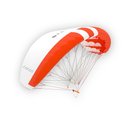
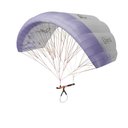
The parawing is a soft, strutless kite, connected to a short bar by lines. You use it to take off on a foil and ride upwind, then fold it in flight to glide without traction, whether downwind or on swells. Depending on the brand, it's also known as a pocket wing.
In short
- The real prerequisite: you need to know how to foil, whether it's wing foil, kitefoil, surf foil, or downwind.
- Your first sessions should be in consistent, side-shore wind, on flat water with no shore break, and never alone.
- You'll need a 4 to 5 m² parawing if you weigh between 70 and 85 kg, along with your familiar wing foil board and foil.
- If you already own a board and foil, your initial budget is just for the parawing itself. You will also need a board leash. Expect to pay between €575 and €1,149 for a 4 to 5 m² model, based on catalog prices as of October 15, 2026. You won't need a harness or waist belt for those first sessions.
Table of Contents
- Who is parawing for?
- What foiling level do you need before starting?
- What conditions are best for your first sessions?
- The steps, from the beach to folding in flight
- Common mistakes we see
- What's the budget to start parawing?
- Where to start around La Baule and Pornichet?
- Things to consider before you start
Who is parawing for?
It's primarily for foilers. At our shop, three profiles come to us looking for their first parawing, and each starts from a different point.
The wingfoiler. This is the most common profile. They've been flying for a season or two, can ride upwind, know how to jibe, and want to recapture that surf foil sensation without dragging an inflatable wing at arm's length. They're already familiar with foil and wind. What they'll learn is steering with lines and folding the parawing.
The surf foiler or downwinder. These riders already know how to glide without traction, often better than wingfoilers. The parawing acts as their engine for taking off and riding upwind, eliminating the need for a boat, a paddle, or a friend waiting at the finish.
The kiter who foils. They have a head start when it comes to steering: they're already familiar with a bar, lines, and the wind window. A 4 m² parawing doesn't pull like a kite. At take-off, all the power comes from your legs.
If you've never stood on a foil, start with wing foil. An inflatable wing remains the simplest way to learn to fly, and our guide to getting started in wing foil will show you the ropes. Parawing will come later, and it won't necessarily replace your wing. It's lighter (650 g for an F-One Quest 4 m² with bar and harness line, according to F-One; approximately 700 g for a Flysurfer POW 2 4 m², as weighed by Hadou Brunner on a kitchen scale), and it fits in a backpack. At the lower end of its wind range, you'll need to pump.
What foil level do you need before starting?
With a wing, if you lose speed, you can lean on the wing for support. With a folded parawing, there's nothing in your hands. And at take-off, the foil and pumping do most of the work. Before your first session, make sure you can:
- take off cleanly, whether with a wing, a kite, or by pumping, without multiple attempts;
- fly on both tacks and hold a line upwind;
- tack or jibe without drifting far downwind;
- fall far from the foil and get back on your board in deep water.
If you're missing any of these skills, spend another season wing foiling or kitefoiling. Every hour of flight you put in will benefit you when you transition to parawing.
When it comes to the wing, our testers offer more subtle opinions than the catalogs. Hydro Gav, for instance, finds the Ozone Pocket Rocket V2 forgiving enough for learning. However, the tester of the F-One Frigate V2 would no longer recommend it for a beginner. For the Duotone Stash, the test published on our blog advises against it for complete parawing beginners, suggesting a generous size if you still opt for it. You'll find detailed information for each model in the comparison.
What conditions are best for your first sessions?
Conditions are more important than the wing itself. A great parawing in gusty, offshore wind will lead to a frustrating first session. An average wing in steady side-shore wind can make for an excellent day on the water.
| Criterion | For your first sessions | To avoid |
|---|---|---|
| Wind Strength | Aim for the middle of your wing's advertised wind range. For example, a 4 m² wing typically has a manufacturer's recommended range between 15 and 25 knots. | Avoid the low end of the wind range, where you'll be constantly pumping, and steer clear of gusts above the high end of the range. |
| Direction | Side-shore or side-on | Offshore conditions are a no-go: a folded wing won't bring you back to shore. |
| Water conditions | Look for flat water or small chop, enough depth for your mast, and plenty of space downwind. | Steer clear of shore break, strong currents, or areas crowded with swimmers or kites. |
| Support | Always ride with others, and make sure someone on shore knows where you are. | Never ride alone at the end of the day, especially when the wind is dying. |
This small detail makes all the difference when downwind: several brands include a backpack that's usable on the water. This includes ALTIS, Ozone with the PowerPack, and Flysurfer with the POW 2. Hydro Gav and our ambassador Damien both highlight the same benefit: it lets you carry a second wing, or a different size, if the wind is uncertain. For your first sessions, stay close to shore and save this option for later.
The steps, from beach setup to in-flight folding
While each wing has its own storage system, the learning progression remains consistent across all. Expect two or three adaptation sessions before your movements become second nature. Our ambassador Damien observed this with the Ozone PowerPack, noting a risk of lines tangling during falls in this initial period.
1. On land: Unfold, identify, and fly
Unfold the wing on the sand with the Leading Edge facing the wind, then identify the lines. Manufacturers use color-coding for clarity: on the Ozone Pocket Rocket, the bar and lines share the same code, while on the F-One Frigate V2, the storage lines are marked in white. Fly the wing for a few minutes at the water's edge to get a feel for its pull, then drop it. You won't learn this any easier once you're in the water.
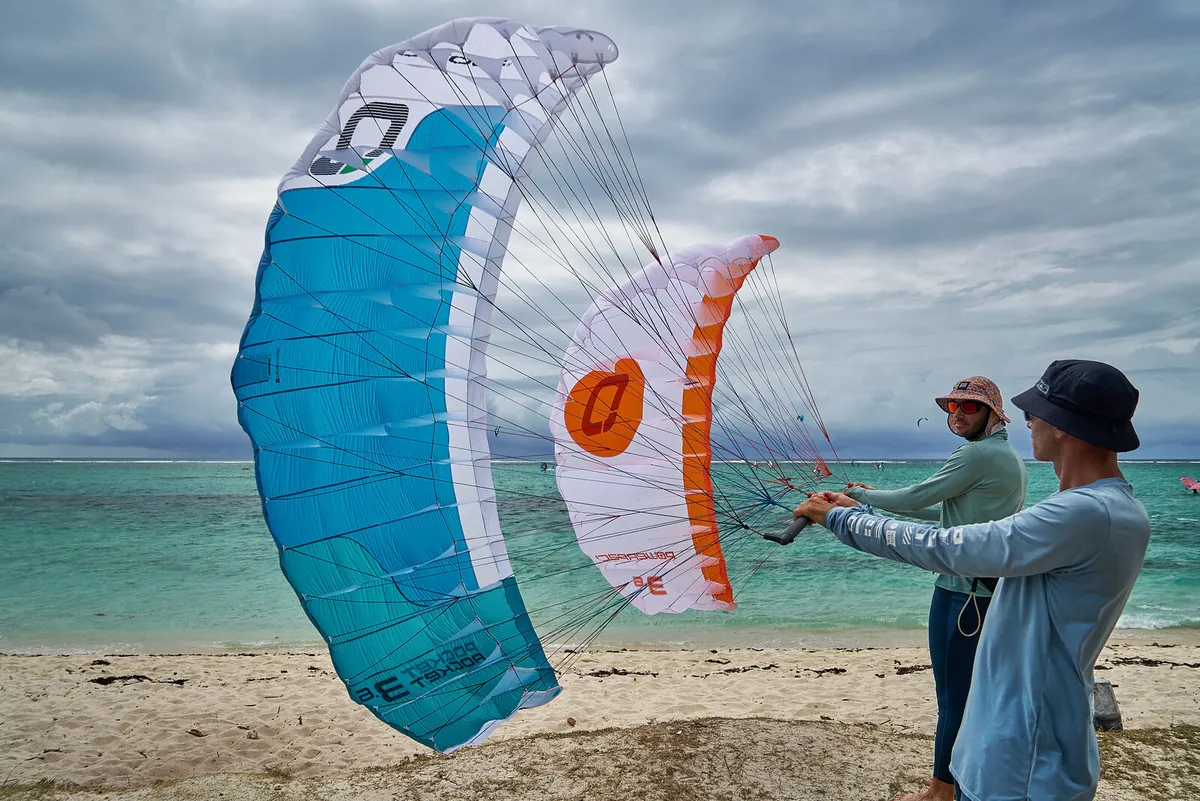
2. Water start, on your knees
The easiest way to start is kneeling on your board, with the wing above your head and the lines taut. Let the wing settle, then stand up and pump. A voluminous board helps immensely, so your wing foil board is perfect for this stage. Hadou Brunner points out that a wing like the Flysurfer POW 2 is forgiving of imprecise hand placement, which is crucial when you're kneeling on a moving board.
3. First upwind runs, wing in hand
Once you're flying, don't try to fold the wing yet. Head upwind, run after run, with the bar in hand. For your first sessions, the only goal is to stay flying. The harness will come later for longer runs. Most wings include a harness line (F-One Quest, Frigate V2, Flysurfer POW 2, ALTIS Focus), and on the Quest, Hydro Gav finds it stiff enough to hook in with one hand. Gaining ground upwind is what will allow you to glide back downwind later.
4. Folding, first at a standstill
Folding involves a dedicated line, often line A: pull it, the wing drops, gather it in one armful, and keep it in hand. Storing it in a belt will come later. Recent wings feature short lines for this; Hadou mentions a single armful on the POW 2 up to 4 m². Practice first while sitting or kneeling on your board with the wing in the air, then try it while flying.
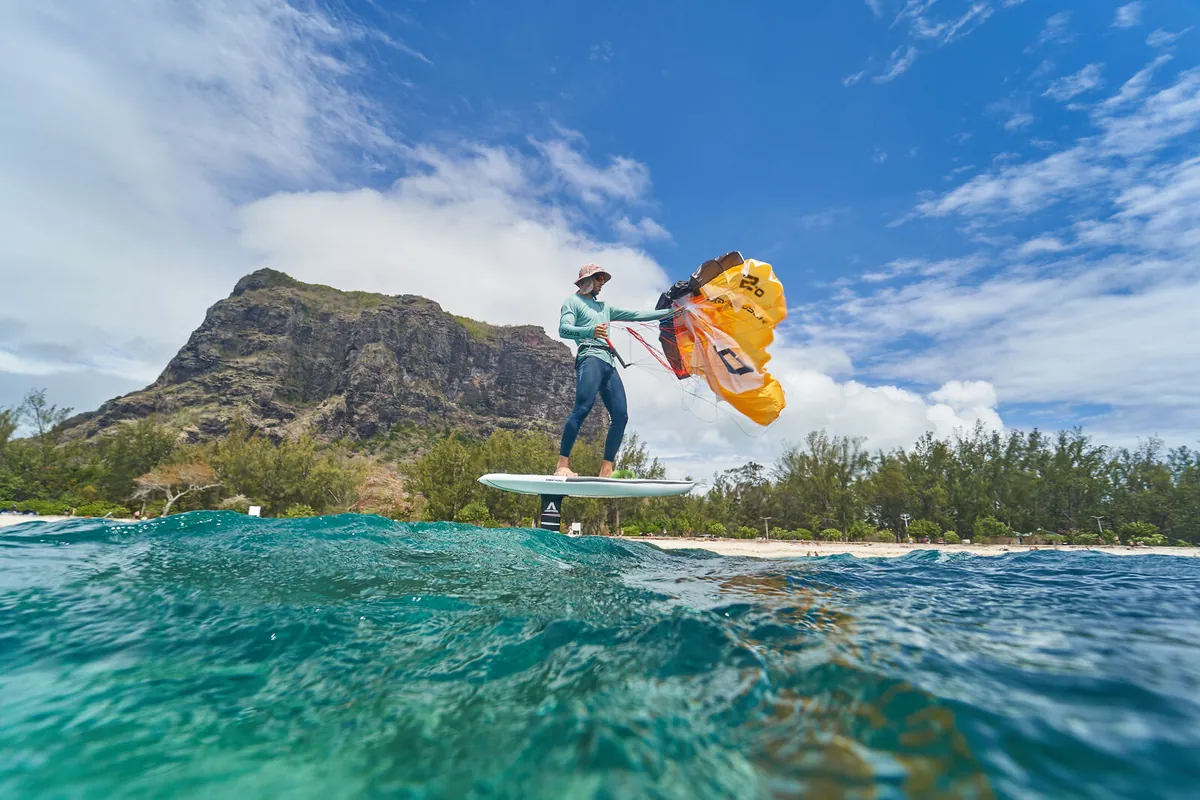
5. Relaunching the wing
If you can't relaunch a folded kite, your session ends with a swim. Hadou describes the motion on the POW 2: grab the front lines, pull, and the kite rights itself, even if it's tangled. Other kites follow the same logic, with varying degrees of ease. Practice this while stationary until you can do it without looking.
6. Turning and jibing
This is the final step, and not the easiest: downwind, the lines quickly slacken. Hadou Brunner recommends a sharp turn, pulling the back lines to pivot the kite. In lulls, he suggests the packing jibe, which involves folding the kite during the turn and then relaunching it. You'll find all the technique in our article on parawing jibing.
The most common mistakes we see
- Don't grab a kite that's too small just because it's on sale. A 2.5 m² kite at 40% off won't get an 80 kg rider flying in 15 knots. Always prioritize the size you need, then look at the price.
- Avoid changing your foil and your kite at the same time. Introducing a new Front Wing and a new traction kite on the same day means you're dealing with two unknowns. Stick with the foil you're familiar with for your initial sessions.
- Don't try to fold your kite on your very first outing. In-flight folding comes after you've mastered upwind runs and stationary relaunches, not before.
- Never let your lines drag. That's how your kite gets tangled, especially after a fall. Keep the bar in hand and your lines taut.
- Don't neglect your relaunch skills. Riders often spend hours practicing folding, only to discover offshore that they can't get their kite back in the air. You need to learn both maneuvers together.
- Never ride offshore or alone. A folded parawing won't get you back to shore. This rule applies to everyone, and it's doubly true when the wind starts to die.
What's the budget to start parawing?
Great news for most riders: if you're already into wing foil, you likely have a board and foil. Your starting budget then focuses on the kite, plus a board leash if yours is a coiled model. Here are the price ranges from our catalog as of October 15, 2026, including any current sales.
| Item | Range | Our recommendations for beginners |
|---|---|---|
| Parawing with bar | €575 to €1,799 | A single skin kite between 4 and 5 m²: the Ozone Pocket Rocket 2025 at €575 for 4.3 m², the ALTIS Focus from 685 to €775, or the Ozone Pocket Rocket V2 or F-One Quest, typically ranging from 900 to €1,200. |
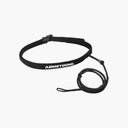
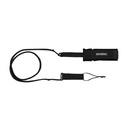
| Board leash | €55 to €129 | An essential item, choose a straight or coiled leash, but never a spiral "phone" leash: the Manera Foil Calf Leash Lite at €55, the Armstrong Downwind Waist Board Leash at €86, or the Ride Engine Tractable Reel Leash with belt at €129. Avoid wrist leashes for parawing. |
| Helmet | €52 to €159 for most | The Manera S-Foam or Mystic Vandal, typically priced around 52 to €100. |
| Parawing belt with pocket | €119.99 to €179 | You won't need this for your first few sessions. Once you're ready to fold in flight, consider the ION Jam Parawing Harness 2027 at €119.99 or the Manera Pocket Wing Belt from 125 to €179, which features an integrated pocket to store your wing. |
| Harness line | Around €19 to €29 | Not essential when you're starting out. It's often included with the wing, but not with the Ozone Pocket Rocket V2. |
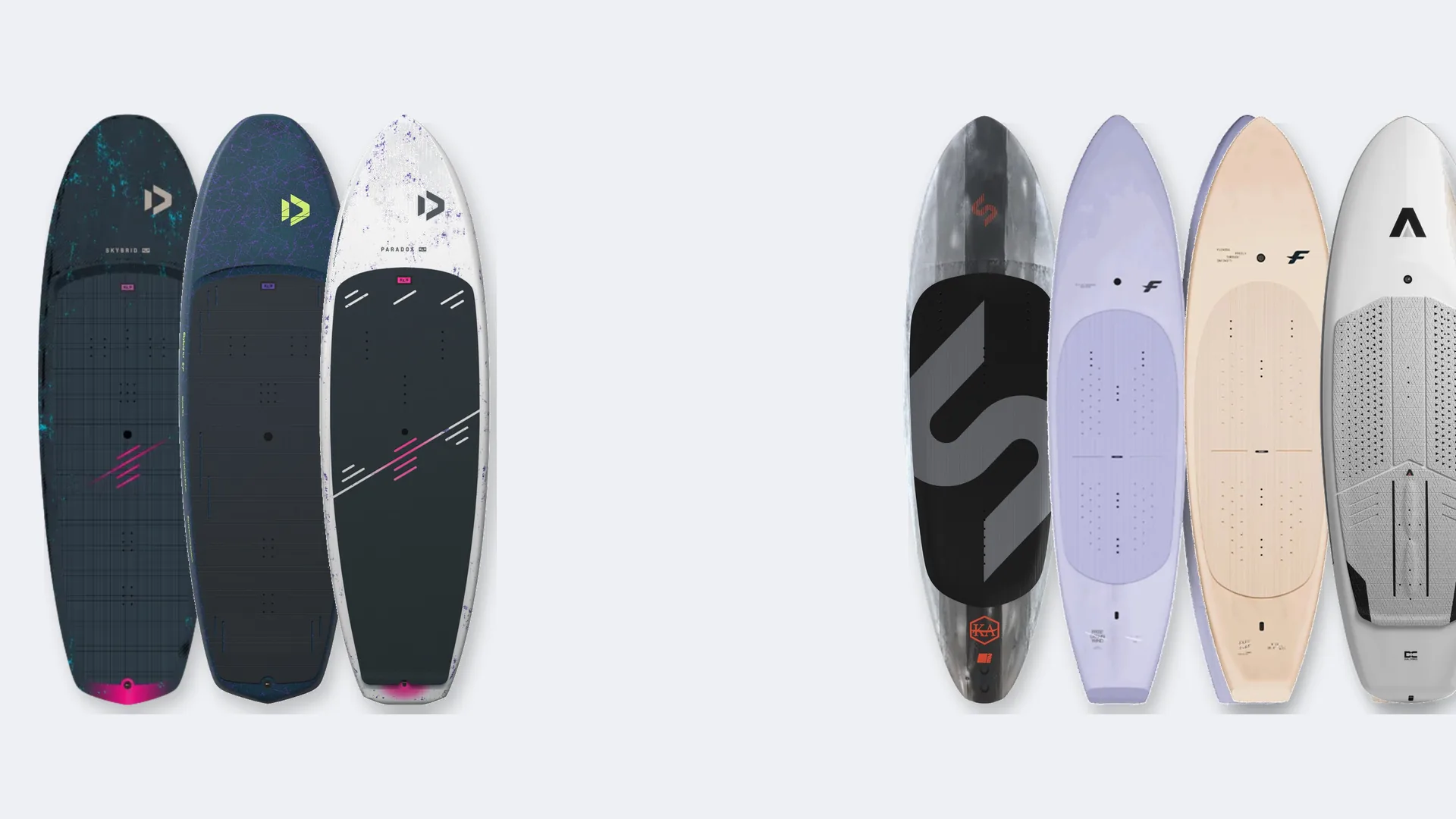
| Parawing board | €999 to €3,199 | You won't need one immediately if your wing foil board has enough volume (our wing foil board guide provides benchmarks). Later, you might consider a board designed by its manufacturer for pocket wing, such as the F-One Rocket Free Surf 2026 (€1,349 to €1,599) or the F-One Rocket Free Downwind 2026 (€1,749 to €1,969). |
| Complete foil | €1,339 to €2,279 | Keep your wing foil for now; these models are on order until October 15th. For future choices, consult our wing foil guide. |
To break it down, if you keep your current wing board and foil, a 4 to 5 m² wing will cost you €575 for an Ozone Pocket Rocket 2025 4.3 m², or €1,149 for an F-One Quest 5 m². Add a board leash if yours is a coiled model. You can hold off on a storage belt and harness line until you're comfortable folding in flight. Sale sizes move quickly, so check the deals table to see what's still available.
Where to start around La Baule and Pornichet?
The bay, stretching from Le Pouliguen to Pornichet, offers two distinct beach launch points. You'll find detailed information on these spots in our La Baule and Pornichet spot guide.
La Baule, Plage Benoît. This spot is ideal with winds from the west to the southeast. At low and mid-tide, the shallow pools create incredibly flat water, perfect for learning to relaunch and practice in-flight folding. At high tide, the space becomes more limited, and the surrounding buildings can disrupt the wind. Get live wind and tide updates on the Plage Benoît weather page.
Pornichet. This spot works with west to northwest winds at all tides. The shore break and shared water with kites and wings make it more technical. It also shares the water with surfboards. This is also where the shop often finishes its downwinds. You can find the spot's anemometer on the Pornichet weather page.
Regulations change during the summer. The K13 kite channel is off-limits for wingfoil, which must use the boat channels instead. The bay regulations, as we know them, don't mention parawing. Before your first summer session, ask the lifeguard station for clarification. Our article on channel regulations covers the rest.
Further afield, Pont-Mahé Bay is perfect for your first independent rides, and the Carnac spotsThese are ideal for beginners, whether you're on a foil or a wing. They offer great range.
Things to Consider Before You Start
This guide is not a substitute for professional instruction. If your wing foil school offers parawing, one or two supervised sessions will save you time when it comes to packing and relaunching.
Each kite has its own deflation and packing system, whether it's an A-line, a handle, or a dedicated belt. Always read the manufacturer's instructions before your first session, and practice on land.
The wind ranges mentioned are provided by the manufacturers for a rider weighing 75 to 80 kg, where specified. These ranges will change based on your weight and board, as well as your foil.
Prices and stock are accurate as of October 15, 2026. Sale sizes and foils on order can change from week to week.
FAQ: Getting Started with Parawing
Can you start parawing without knowing how to foil?
It is possible, but it takes much longer. The parawing helps you take off and go upwind on a foil, then it folds up. Once stowed, only the foil supports you. The simplest way is to first learn to fly with wing foil, kitefoil, surf foil, or downwind.
What wind conditions are best for a first parawing session?
Look for a steady, side-shore or side-on wind, in the middle of your kite's wind range. For 4 m², manufacturers' stated ranges overlap between 15 and 25 knots. Avoid offshore winds and gusts.
Do you need a harness to start parawing?
No, not for the first sessions. The goal is to fly, then fold the kite while keeping it in hand. A harness and storage belt come later (ION Jam Parawing Harness 2027 at €119.99, Manera Pocket Wing Belt from 125 to €179 as of October 15, 2026). The harness line is supplied with most kites (F-One Quest, Frigate V2, Flysurfer POW 2, ALTIS Focus), but not with the Ozone Pocket Rocket V2. A leash, however, is essential: use a straight or coiled board leash, not a wrist leash.
Which board should you use to start parawing?
Use your wing foil board if it has volume. Later, a long and narrow board, mid-length or downwind, takes off earlier once the kite is folded. F-One recommends this type of board with its pocket wings.
How much does parawing equipment cost to start?
If you already have a board and a board leash, or a foil, you only need the wing: from €575 (Ozone Pocket Rocket 2025 4.3 m²) to €1,149 (F-One Quest 5 m²) in 4 to 5 m², catalog price as of October 15, 2026.
Where can you learn parawing near La Baule?
At Benoît beach, go at low or mid-tide. The tidal pools create flat water there, with west to southeast winds. Pornichet is more technical because of its shore break. In summer, ask at the lifeguard station about which channels to use.
Want an opinion on your current gear?
Tell us your weight, board, foil, and spot. We'll let you know if your current setup works and which parawing to add.
View parawings section Contact us Call us
Sources and limitations: Test feedback published on our blog (Ozone Pocket Rocket V2 and Pocket Rocket 2025, F-One Quest, F-One Frigate V2, Flysurfer POW 2, ALTIS Focus and Focus Hybrid, Ozone PowerPack, Duotone Stash) and Hadou Brunner's article on the jibe. The weight of the F-One Quest 4 m² is from f-one.world, and the weight of the Flysurfer POW 2 4 m² was measured by the tester. Wind ranges are based on manufacturer specifications found on our product sheets. Spot information and regulations are from our La Baule bay guides. Catalog prices and sales were recorded on 10/15/2026, as was GlissEvolution stock. Photos by Ozone (PowerPack 2026).